Document the place
Start with the site's name, alternate names, location, coordinates, photographs and date of documentation. Names can change across languages and historical periods, so recording variants helps researchers find older literature.
Explore archaeological sites, monuments, buildings, traditions and cultural landscapes that shaped Pakistan — and discover what remains, what has disappeared, what has been documented, and what is at risk.
A research-oriented archive — not a tourism guide. Status labels are evidence-led and may change as documentation improves.
Pakistan's heritage includes excavated cities, living religious traditions, forts, tombs, inscriptions, historic homes, railway infrastructure, craft knowledge and landscapes shaped by centuries of movement. Some survive in good condition. Others survive only as fragments, records, archaeological deposits or community memory.
This archive therefore avoids treating “lost†as a blanket label. Each record carries a status such as ruined, endangered, partially surviving, historically recorded or archaeologically documented. Where evidence is uncertain, the uncertainty is visible.
Completely disappeared: physical remains are no longer known to survive, while documentation may remain.
Ruined: substantial remains survive but the original structure or complex is incomplete.
Abandoned: a place may remain physically present but no longer perform its former function.
Endangered / at risk: documented pressures may threaten fabric, context or continuity.
Partially surviving: fragments, foundations, sections or associated remains survive.
Historically recorded: the archive can document the historical existence or significance but needs stronger present-condition evidence.
Flooding, erosion, salt, humidity, earthquakes and changing water regimes can alter archaeological deposits and building fabric.
Urban expansion, infrastructure, insensitive construction, neglect and unauthorized alterations can change heritage context.
Looting and illicit antiquities trafficking can remove objects from archaeological context, reducing what researchers can learn from them.
Heritage also lives in knowledge and practice: traditional instruments, oral traditions, astronomical knowledge, craft skills, festivals, languages and foodways. UNESCO's Pakistan inventory includes Suri Jagek, inscribed in 2018 on the List of Intangible Cultural Heritage in Need of Urgent Safeguarding, and Boreendo/Bhorindo, inscribed in 2025.
Explore intangible heritage researchStart with the site's name, alternate names, location, coordinates, photographs and date of documentation. Names can change across languages and historical periods, so recording variants helps researchers find older literature.
Connect every major statement to a source. Archaeological reports, official heritage inventories, museum records, maps, inscriptions and peer-reviewed research each answer different kinds of questions.
Not every date, attribution or function is certain. A responsible archive keeps disputed interpretations visible rather than presenting the most attractive story as settled fact.
Settlement: How was the place organized? What evidence survives for streets, houses, workshops, storage or public structures?
Environment: How did rivers, rainfall, soil, vegetation and changing climate shape occupation and abandonment?
Technology: What do bricks, pottery, metals, stone tools, pigments and building techniques reveal about production?
Movement: Do inscriptions, coins, raw materials or architectural styles indicate contact with other regions?
Memory: How has a community reused, remembered or reinterpreted a historic place after its original function changed?
A claim supported by a published excavation report, official inventory, archival document, inscription, measured observation or other identifiable evidence.
A scholarly explanation built from evidence. Interpretations can be strong without being directly observable and may change when new evidence appears.
A proposed explanation that still requires testing. Hypotheses are useful when clearly labelled and supported by a reasoned argument.
Select one site and create a one-page research brief: identify the historical period, location, heritage type, evidence base, excavation history, present condition and three questions that remain unresolved. Then locate at least two institutional sources and one academic publication. Compare their dates, terminology and interpretations. This simple exercise teaches a core archaeological skill: the ability to move from a broad historical story to a traceable evidence trail.
For a longer project, add GIS mapping, architectural documentation, material analysis or oral-history interviews where appropriate and legally authorized. Record the limits of every method. A strong heritage project is not the one with the most dramatic claims; it is the one where another researcher can understand how each conclusion was reached.
A sample of documented sites spanning all seven of the archive's geographic sections. Full photographic sourcing and licensing notes for each image are available on its Wikimedia Commons file page; open a record's research page for site-specific attribution.
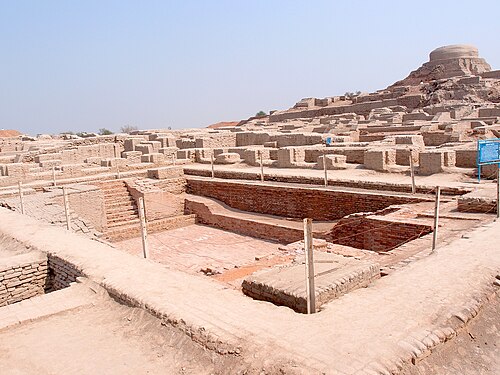


Indus archaeology, Mughal and Sikh architecture, colonial urbanism.
Urban archaeology, necropolises, ports and river landscapes.
Gandhara, Buddhist monasteries, historic trade routes.
Early farming, Bronze Age networks, coastal archaeology.
Mountain forts, rock art and Silk Road landscapes.
Caves, forts and heritage inside the modern capital.
Mountain forts and historic river-valley settlements.
See every documented record plotted geographically.
No. Pakistan Lost Heritage is an independent educational archive. It cites official and scholarly sources but is not itself a heritage authority, excavation permit or legal register.
Photographs are drawn from Wikimedia Commons and carry their own individual licenses. Check each image's Commons file page for the exact license and required attribution before reuse.
Status labels are reviewed periodically. Conservation status, ownership and site condition can change; always cross-check against a current authoritative source before citing a status in formal work.
Yes — the contact page explains what information makes a correction easy to verify and add.